NEW - SIL Registration, Practice Standards & Rules
Supported Independent Living (SIL) — short explanation
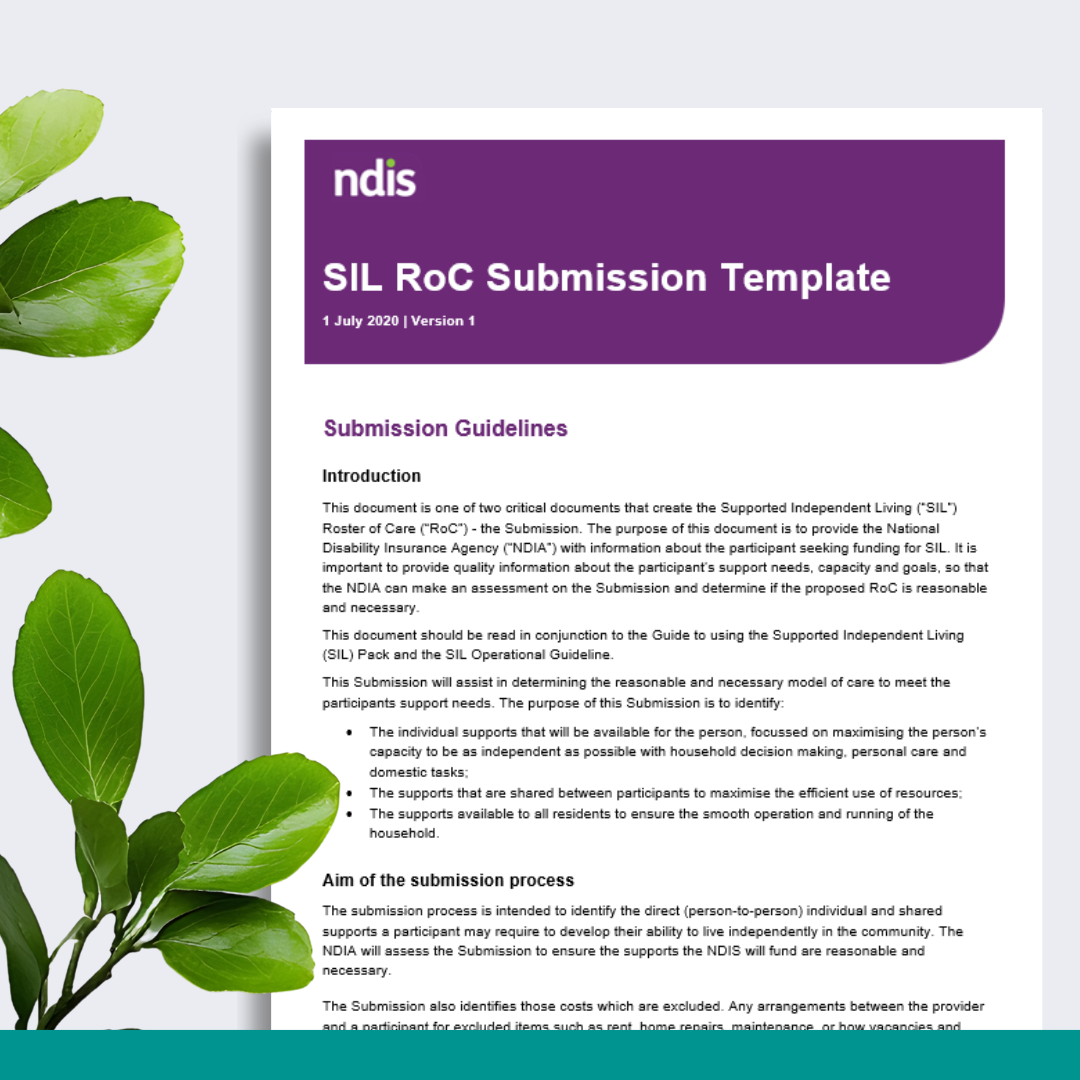
- What it is: SIL (Supported Independent Living) funds the supports a participant needs to live as independently as possible in a home setting. It covers daily personal care, household tasks, and functional supports provided to a person (or people in a shared house) to assist with daily living. SIL funding is obtained post submission of a Roster of Care(ROC) from a registered provider.
- Who it’s for: NDIS participants who needs overnight support and regular, ongoing assistance with personal care, household tasks or to develop independence skills — often people with higher support needs who require staff availability across waking hours or 24/7.
- What SIL funds (typical): personal care, behaviour support implementation, assistance with daily living tasks, supervision related to safety and health, skill-building for independence, staff rostering and on-call arrangements.
- What SIL does NOT fund: food, utilities, the cost of the house itself (rent or mortgage), capital modifications (those can be SDA or home modifications), or general tenancy costs — though some tenancy-related supports may be arranged separately.
- Relationship to SDA: SIL is about the supports (staffing). SDA (Specialist Disability Accommodation) is funding for housing design and construction for people with very high and complex needs. A participant can have both SDA (for housing) and SIL (for staffing).
- How it’s arranged: SIL needs to be included and funded in a participant’s NDIS plan after needs are assessed and agreed. It usually involves a support plan specifying the staffing model, rostering, participant goals and responsibilities of the SIL provider.
- Providers & safeguards: SIL is delivered by registered providers; high‑quality SIL usually includes clear rosters, behaviour support plans (if needed), medication management, incident reporting and monitoring by the NDIS Commission.
NEW - SIL REGISTRATION (MODULE 5a)
Mandatory registration begins 1st July 2026 for all ndis providers offering SIL support across Australia. Read More HERE - https://www.ndiscommission.gov.au/about-us/ndis-commission-reform-hub/mandatory-registration/mandatory-registration-SIL
NEW - SIL CODE (MODULE 5a)
New price guide SIL code to register or renew for is 0138
NEW - SIL PRACTICE STANDARDS (MODULE 5a)
PRACTICE STANDARD 1
Each participant is supported to understand and make genuine decisions for themselves. Each participant is provided with accessible information, and decision‑making support, about: the supports and services delivered in their home; and the supports and services delivered to enable them to access their community. To achieve this outcome, the following indicators should be demonstrated:
- Each participant is provided with information to help them communicate their will and preferences about the delivery of supports and services in their home and daily life. This information is provided using the language, mode of communication and terms that the participant is most likely to understand.
- Each participant’s right to the dignity of risk in decision-making about the delivery of supports and services in their home and daily life is supported. When needed, each participant is supported to make informed choices about the benefits and risks of the options under consideration about their home and daily life.
- Each participant is supported to make informed decisions about access to mainstream supports and services outside of their home.
Policies and procedures are in place to facilitate supported decision-making by workers. The policies and procedures should require workers, when facilitating supported decision-making about the delivery of supports and services in a participant’s home and daily life, to:
provide a reasonable period to implement supported decision-making;
identify the circumstances in which supported decision-making may be required;
seek participant views on whether decision-making support is required and how they would like to be supported;
identify and provide the necessary decision-making support in accordance with the participant’s will and preferences;
consider and respond to cultural values and beliefs when decision-making support is required; and
identify when additional support may be required for day-to-day decision-making including by an authorised decision maker such as a nominee.
- Relevant workers are trained, and have refresher training, in supported decision-making, including how to support the development of the participant’s ability to make decisions about the delivery of supports and services in a participant’s home and daily life and understand the impact of their decisions.
PRACTICE STANDARD 2
Each participant is supported to live in a safe, respectful and supportive home environment. Each participant is supported to have adequate safeguards in place to mitigate harm at home and when participants access their community. To achieve this outcome, the following indicators should be demonstrated:
- Relevant workers demonstrate compliance with their obligations under the NDIS Code of Conduct through respectful, safe and rights-based support in a participant’s home in the delivery of supports and services.
- Policies and procedures are in place to balance and respect participants’ dignity of risk in decision-making about the delivery of supports and services in their home and daily life while upholding obligations to safety in the home and when accessing their community. This includes involving participants in safeguarding discussions and ensuring safeguarding approaches are understood and applied consistently by all workers in the participant’s home.
- Relevant workers delivering supports and services in a participant’s home and daily life have the skills to identify, assess and respond to harm, bullying and conflict in the participant’s home or when in the community, in a timely manner. This includes ensuring workers are trained in de-escalation, trauma-informed practice and positive behaviour support.
- Each participant is supported to strengthen their formal and informal safeguards by being supported through the design and delivery of their supports and services to maintain access to their family, friends and community and through building stable and consistent relationships with workers who deliver supports and services in the participant’s home and daily life.
- Each participant is supported to understand the impact of their decisions about the delivery of supports and services in their home and daily life if there is risk associated with their choices about their home and access to their community.
- Policies and procedures are in place that set out the responsibilities of relevant workers delivering supports and services in the participant’s home and daily life in identifying, assessing and responding to risks such as bullying and conflict in the home environment. This includes requiring workers to collaborate with relevant providers and specialists to manage and mitigate risks in a person-centred and consistent manner to safeguard the participant and others living in the participant’s home.
- Safeguarding approaches are implemented to address conflict, intimidation and harm between participants. This includes providers consulting with participants to ensure the safeguarding approaches acknowledge the risk and safety unique to each person, while respecting their autonomy.
- Safeguarding approaches are regularly reviewed with participants and adjustments are made to promote continuous quality improvement through day-to-day practice improvements in the participant’s home, worker learning, supervision and governance.
PRACTICE STANDARD 3
Each participant is supported in their home by workers that have the necessary training, knowledge and skills to support them. Each participant is supported by workers that have the knowledge of, and guidance to use, evidence informed practices that:
(a) are tailored to the participant’s needs; and
(b) enable the provision of safe and high quality supports.
To achieve this outcome, the following indicators should be demonstrated:
- Policies and procedures are in place for planning, delivery and evaluation of worker development and training, ensuring workers have skills and competency to deliver supports and services to participants in their home. This includes appropriate mentoring, supervision and training for workers in relation to cultural safety and positive behaviour support.
- Each participant is supported in a positive, comfortable and safe home environment by implementing trauma-informed practices in the delivery of supports and services in a participant’s home and daily life.
- Workers are trained and assessed as competent in evidence-based practices including person-centred and trauma-informed practices, active support and supported decision-making, to create a participant centred and safe environment for the delivery of supports and services in a participant’s home and daily life.
- Policies and procedures are in place that document a vision, values, objectives and strategies for the delivery of supports and services in the home that reflects contemporary practice and prioritises participants’ rights, safety and wellbeing in the participant’s home.
- Each participant is provided the opportunity and encouraged to participate in and make decisions about their home including who they live with. This includes consultation with impacted participants before placing new tenants in the home and ensuring that participants are matched with co-tenants that they feel safe to live with.
- Appropriate governance oversight of emergency planning is in place in shared living. All impacted participants are consulted to ensure emergency arrangements are coordinated, rehearsed and tailored to individual needs to ensure participants can respond safely to emergencies.
PRACTICE STANDARD 4
Each participant who has a tenancy agreement with the provider is supported to understand how the terms and conditions of the tenancy agreement interact with their service agreement with the provider. Each such participant is supported by effective tenancy management and is able to exercise choice and control and their tenancy rights. To achieve this outcome, the following indicators should be demonstrated:
- Where a provider is delivering both assistance with supported independent living and tenancy to the same participant, there are separate service and tenancy agreements.
- Each participant who is receiving both assistance with supported independent living and tenancy from the same provider is supported to understand the distinction between their service agreement and tenancy agreement, including that they are legally separate and that one is not contingent on the other. This includes requiring workers to refer participants to access independent advocacy or legal assistance to understand their rights and responsibilities.
- Policies and procedures are in place that detail how perceived or actual conflicts of interests are identified and managed by a provider that is delivering both assistance with supported independent living and tenancy to the same participant. The conflict of interest policies are made available to participants in the language, mode of communication and terms which each participant is most likely to understand.
- Policies and procedures are in place to ensure participants can raise concerns about their supports and tenancy management without fear of retribution. This includes requiring workers to assist participants to access advocacy and/or legal services where appropriate.
- Each participant who is receiving both assistance with supported independent living and tenancy from the same provider is supported in their tenancy:
- By the provider providing accessible information and support to ensure the participant understands their rights and responsibilities under relevant tenancy law. This includes information about their house-sharing arrangements, notice periods and exit processes.
b. By the provider providing, when required by the participant, more detailed assistance to understand their rights and responsibilities, including to access advocacy and/or legal services.
c. To understand their rights to change, in whole or in part, the provider who delivers assistance with supported independent living at any time during the tenancy agreement, and there are appropriate participant centred arrangements to facilitate this.
d. To be involved in decisions about their home environment including how shared spaces should be used.
e. To have access to house keys and to have private spaces that are managed in accordance with their preferences and subject to paragraph (f). This includes ensuring participants have the right to control who enters their private space.
f. By not having any limits applied to their access or possessions, unless there is a behaviour support plan in place for the participant. Any limits to access or possessions are applied in the least restrictive way possible and in accordance with their behaviour support plan.
g. By the provider maintaining ongoing compliance with all relevant laws and standards, including building standards and tenancy laws that apply to disability accommodation.
h. To understand their tenancy agreement, including any conditions, by using the language, mode of communication and terms which that participant is most likely to understand.
i. To have a copy of their agreement as signed by the participant and the provider. Where this is not practicable, a record is made detailing the circumstances in which the participant did not receive a copy of their agreement. - Each participant is supported to have a written service agreement in place that set out the following matters:
a. How a participant’s concerns about their home will be communicated and addressed;
b. How potential conflicts involving co-tenants will be managed;
c. How changes to participant circumstances and/or support needs will be agreed and communicated;
d. How vacancies will be filled, including each participant’s right to have their needs, preferences and situation taken into account;
e. How behaviours of concern, which may put tenancies at risk will be managed, if this is a relevant issue for the participant; and
f. How participants can have visitors in their home, including how participants will be supported to exercise this choice safely without unnecessary restrictions.
ONE PLACE. TOTAL SUPPORT
Expert NDIS support, ongoing guidance — we make compliance simple, time‑efficient and affordable so you can focus on care. Business Consulting, HR Management, NDIS Registration, Internal Auditing, Service Delivery, Compliance, IT systems & more.
- Call us: 1800 611 661 or text "HELP" to 0475 12 33 99 for immediate support.
- Email: contact@disabilitycompliance.com.au
- Start/Strengthen My Service (Unregistered providers)
- Register/Renew My Service
- Audit My Service
- Grow My Service
- IT Support
Products